

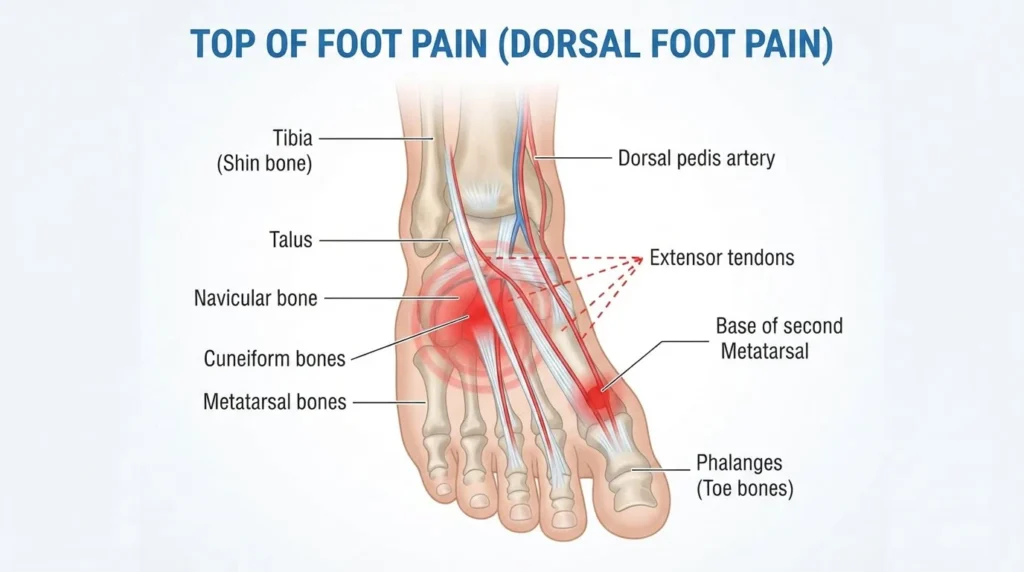
Quick Answer
Top of foot pain stems from overuse, tight shoes, or underlying conditions like tendinitis and stress fractures. Most cases improve with rest, ice, and proper footwear within 2-4 weeks. If pain persists beyond a month or worsens, see a healthcare provider to rule out fractures or nerve damage.
Table of Contents
- What Causes Top of Foot Pain?
- How to Diagnose Your Foot Pain
- Proven Treatment Methods That Work
- Prevention Strategies That Stick
- When You Really Need Medical Help
- Real-World Examples
- Expert Insights
- FAQs
Introduction:
Your foot hurts. Specifically, the top of your foot throbs after walking, running, or just standing around. You Google it. You panic. You wonder if you’ll ever be normal again.
Here’s what you need to know: top of foot pain is incredibly common, and it’s rarely as serious as your mind makes it out to be. Most people experience this type of pain at some point, whether they’re athletes, desk workers, or just someone who wore uncomfortable shoes to a wedding.
The real problem? People ignore it. They assume it’ll go away on its own. Sometimes it does. Often, it gets worse because you keep doing the same things that caused the pain in the first place.
This guide walks you through everything you need to know about top of foot pain. What causes it, why it happens, how to treat it, and most importantly, how to prevent it from ruining your life again. We’re talking practical solutions, not just generic advice you’ve already heard a million times.
What Causes Top of Foot Pain?
The Most Common Culprits Behind Top of Foot Pain
Top of foot pain doesn’t just appear for no reason. Something triggered it. Your job is to figure out what.
Extensor Tendonitis is probably the most frequent cause. These tendons run along the top of your foot and straighten your toes. When you overuse them, they get inflamed. Runners love to develop this. So do people who suddenly increase their activity level. You feel a sharp pain on top of your foot, especially when you try to flex your toes upward.
Stress fractures are the scarier possibility. These are tiny cracks in your bones that develop gradually. They hurt more with activity and feel better with rest. You don’t need a dramatic fall or accident. A stress fracture sneaks up on you through repetitive impact. Dancers, runners, and military personnel see this frequently.
Cuboid syndrome affects that odd-shaped bone on the outer side of your foot’s arch. It subluxates (partially dislocates), and boom. Top of foot pain radiates outward. This one trips people up because it mimics other conditions.
Foot ligament sprains happen when you roll your ankle or twist your foot awkwardly. The ligaments connecting your bones get stretched. They’re sore. They swell. Top of foot pain follows. This is different from a fracture, but both require proper care.
Hallux limitus is a fancy way of saying your big toe joint moves poorly. When it doesn’t bend correctly, your other toes overcompensate. Pressure builds on top of your foot. Pain develops. It’s sneakier than it sounds.
Poor footwear choices cause more top of foot pain than people admit. Shoes that are too tight, have no arch support, or force your foot into an unnatural position? They’ll cause problems. Your foot isn’t designed for that. Eventually, it complains.
Gait abnormalities mean you walk funny without knowing it. Maybe you overpronate. Maybe you supinate. Either way, your foot mechanics are off. Muscles overwork. Tendons protest. Pain happens.
How to Diagnose Your Foot Pain
Figuring Out What’s Actually Wrong
Before you treat top of foot pain, you need to know what you’re dealing with. Not all foot pain is the same.
Start by paying attention to where it hurts exactly. Is it on the very top, the side, or closer to your arch? Does it hurt during specific activities? Does it throb constantly or only when you move?
The simple tests you can do at home:
Press gently on different areas of your foot. Where does it hurt most? That’s your hint. If pressing causes sharp, localized pain, you might have a stress fracture. If it’s a dull ache across a broader area, tendonitis is more likely.
Try flexing your toes upward without moving your foot. If this causes pain, extensor tendonitis is probably your issue. The extensors run right there, and they’re working hard when you do this movement.
Check your swelling. Is your foot swollen? Where? Swelling over the top of your foot suggests inflammation, often from tendinitis or a sprain. Swelling on the inside arch points toward different problems.
Walk around. Does it hurt more on your heel, ball of your foot, or genuinely the top? This matters because it narrows down what structure is involved.
When you need professional evaluation:
If pain lasts more than two weeks, gets worse, or you notice significant swelling, see a doctor. They can order X-rays to check for fractures. They can assess your gait. They can palpate your foot properly. MRI might be needed if they suspect soft tissue damage.
A foot specialist (podiatrist) or orthopedic doctor can give you definitive answers. They’ve seen thousands of feet. They know what they’re looking at.
Proven Treatment Methods That Work
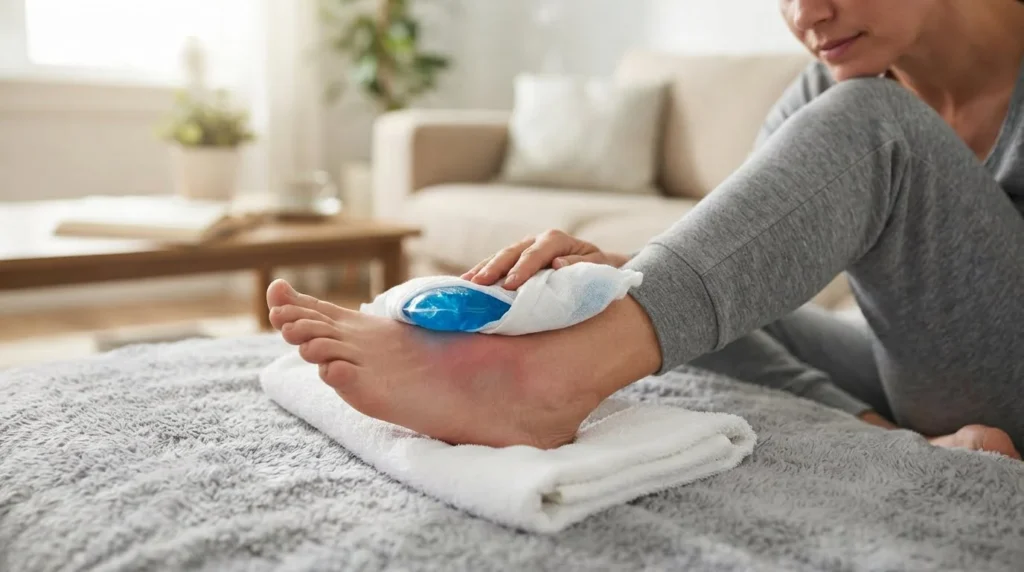
Getting Top of Foot Pain Relief
The good news? Most top of foot pain responds to conservative treatment. Surgery is rarely necessary.
Rest truly works. Stop the activity that triggers pain. This sounds obvious, but people keep running, keep dancing, keep doing whatever caused the problem. Your foot needs a break. Give it one. Even a few days of reduced activity helps.
Ice reduces inflammation. Apply ice for 15-20 minutes, several times daily. Wrap ice in a cloth so you’re not freezing your skin directly. Ice constricts blood vessels and reduces swelling. Swelling drives pain. Less swelling means less pain.
Compression helps too. Wrap your foot snugly with an elastic bandage. This prevents additional swelling and provides mild support. Don’t wrap so tight that you cut off circulation. You should be able to slide a finger under the bandage.
Elevation matters more than people think. When your foot is below your heart, fluid pools there. Gravity is a real jerk. Elevate your foot above heart level when you’re resting. The swelling decreases noticeably.
Non-steroidal anti-inflammatory drugs (NSAIDs) like ibuprofen reduce inflammation. Take them as directed on the package. They work better when you start them early. If you’ve had the pain for weeks, they’re less effective.
Proper footwear changes everything. Switch to shoes with good arch support. Get something with cushioning. Avoid tight shoes. Your foot expands slightly during the day, so morning shoe size isn’t your true size. If you’re serious about recovery, replace your regular shoes temporarily. Most people are shocked at how much better they feel wearing proper footwear.
Stretching and strengthening exercises accelerate recovery once acute pain improves. Calf stretches help. Toe curls with a towel strengthen your arch. Ankle circles build stability. Start gentle. Progress gradually.
Night splints hold your foot in a stretched position while you sleep. This maintains flexibility and reduces morning stiffness. They’re particularly useful for extensor tendonitis.
Custom orthotics work when off-the-shelf shoe inserts don’t. A podiatrist creates molds specifically for your feet. These correct your gait and redistribute pressure away from painful areas. They’re expensive upfront but worth it if standard approaches fail.
Real Examples From Real People
Stories That Actually Happened
Sarah’s Running Nightmare:
Sarah trained for a half-marathon. She increased her mileage too quickly. Within weeks, sharp pain appeared on top of her foot. She ignored it for two weeks. It got worse. Finally, she stopped running and started icing. Combined with proper shoes and calf stretches, she recovered in four weeks. She learned that gradual increases matter. She never increased mileage by more than 10% weekly again.
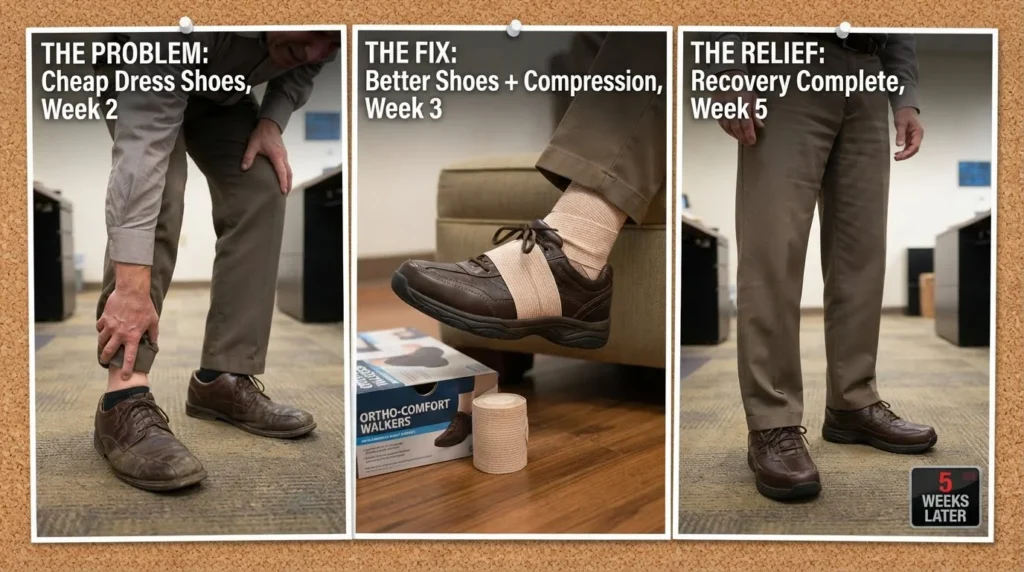
Mike’s Shoe Problem:
Mike started a new job that required him to be on his feet all day. His cheap dress shoes destroyed his feet. Top of foot pain developed within two weeks. A proper footwear investment changed everything. Better shoes, an elastic bandage for compression, and three weeks of reduced activity fixed it. No medication needed. No doctor visit required. Just better shoes.
Jennifer’s Unexpected Cuboid Syndrome:
Jennifer stepped off a curb wrong. Her foot twisted. foot pain on top of developed immediately. She thought she’d sprained her ankle, but X-rays showed nothing. A physical therapist diagnosed cuboid syndrome. Manual manipulation, taping, and specific exercises resolved it in three weeks. She learned that foot injuries can be weird and that professional diagnosis matters.
Case Study: Overtraining Leads to Stress Fracture
The Situation:
A 28-year-old distance runner trained for an ultra-marathon. She ran 50+ miles weekly. One week, she pushed beyond her usual mileage. Sharp pain appeared on top of her foot. She assumed it was normal training soreness.
What Happened:
She kept running. The pain worsened. A stress fracture developed in her metatarsal bone. She finally saw a doctor after missing training for a week already.
The Treatment:
Six weeks of walking boot. No running whatsoever. Physical therapy starting week four. Gradual return to running over eight weeks.
The Lesson:
Ignoring top of foot pain is dangerous. What seems like minor discomfort can become a serious injury. Also, training plans matter. Gradual progression prevents disaster. She’s back to running, but she’s smarter about her approach now.
Comparison Table: Treatment Options
| Treatment | Cost | Speed | Effectiveness | Best For |
|---|---|---|---|---|
| Rest & Ice | Free | 2-4 weeks | High for mild cases | Initial treatment |
| OTC Shoe Inserts | 20-50 | 3-6 weeks | Good | Mild to moderate |
| Custom Orthotics | 300-800 | 4-8 weeks | Very high | Chronic cases |
| Physical Therapy | 100-200/session | 4-8 weeks | High | Persistent pain |
| Doctor Visit + Imaging | 150-500 | 1-2 weeks diagnosis | Very high | Ruling out fractures |
| Night Splints | 50-100 | 2-4 weeks | Moderate | Tendonitis |
| NSAIDs | 5-15 | 1-2 weeks | Good | Inflammation reduction |
Statistics and Research
Studies show that foot pain on top of affects roughly 3-5% of the population annually. Running-related injuries account for about 50% of cases. Among amateur runners, overuse injuries from rapid training increases cause the majority of problems.
Research indicates that proper footwear reduces foot pain incidents by 30-40% in high-risk populations. Physical therapy shows 70-80% success rates for non-surgical treatment of extensor tendonitis.
Stress fractures account for approximately 15% of running injuries. Early diagnosis and proper treatment reduce recovery time significantly compared to delayed intervention.
A study published in the Journal of Foot and Ankle Research found that custom orthotics improved outcomes in 85% of patients with chronic foot pain on top of who didn’t respond to standard treatments.
Expert Insights
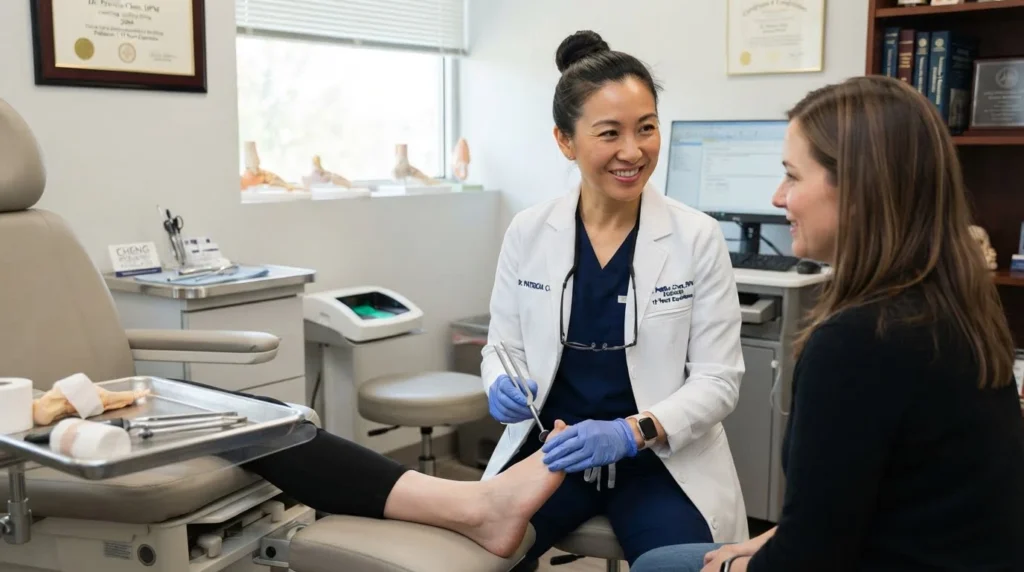
Dr. Patricia Chen, DPM, podiatrist with 15 years experience:
“Most patients with foot pain on top of come to me hoping for quick fixes. They want injections or surgery. What they really need is rest and better footwear. I’d say 80% of my patients improve with conservative treatment. People just need patience and consistency. They also need to understand that their body is telling them something. Listen to the pain.”
James Rodriguez, physical therapist specializing in lower body:
“Top of foot pain often isn’t just about the foot. I look at the whole kinetic chain. How’s your hip? Your ankle? Your calf? Often, weakness elsewhere forces your foot to overcompensate. Fixing foot pain on top of means addressing everything.”
Coach Maria Santos, track and field coach:
“Athletes with top of foot pain usually trained too hard, too fast. The rule is simple: increase gradually. Never more than 10% weekly. CrossFitters are the worst for this. They come in without a build-up phase and get hurt immediately. Smart training prevents most injuries.”
Frequently Asked Questions (Questions Only)
- How long does top of foot pain typically last?
- Can top of foot pain go away on its own?
- What’s the difference between top of foot pain and a stress fracture?
- Should I keep exercising if my foot hurts?
- Will custom orthotics really help my pain?
- Is physical therapy necessary for top of foot pain?
FAQ Section
How long does top of foot pain typically last?
Most cases resolve within 2-4 weeks with proper treatment. Some take 6-8 weeks. Stress fractures need 6-12 weeks. If pain persists beyond 12 weeks, you likely need professional intervention. Chronic cases sometimes take months, but they do improve with consistent treatment and patience.
Can top of foot pain go away on its own?
Sometimes. Mild cases from minor overuse might resolve with rest alone. But ignoring pain is risky. Minor injuries become major ones when left untreated. Taking immediate action with ice, rest, and proper shoes accelerates recovery and prevents complications. Don’t gamble with your health.
What’s the difference between top of foot pain and a stress fracture?
Stress fracture pain is typically sharper, more localized, and worsens with impact activities. Tendonitis pain feels more like a dull ache or burning sensation. A doctor needs to confirm stress fractures with imaging. Top of foot pain from other causes usually improves within days with rest. Stress fractures need weeks.
Should I keep exercising if my foot hurts?
Not the activity causing pain. Stop running, dancing, or whatever triggered it. Switch to low-impact exercise like swimming or cycling if pain-free. Your body is telling you something is wrong. Pushing through foot pain on top of rarely leads anywhere good.
Will custom orthotics really help my pain?
Yes, for most people. If standard approaches fail after 4-6 weeks, custom orthotics have an 80-85% success rate. They’re expensive but effective. Insurance sometimes covers them with proper documentation. They’re worth exploring if conservative treatment stalls.
Is physical therapy necessary for top of foot pain?
Not always initially. Start with rest, ice, and proper shoes. If pain persists beyond 3-4 weeks, physical therapy helps tremendously. A therapist teaches you specific exercises, assesses your gait, and identifies underlying issues. Most people benefit from at least a few sessions.
Conclusion:
Top of foot pain is common, frustrating, and usually fixable. The key is taking action early. Rest, ice, compression, and elevation work for most cases. Proper footwear matters more than people realize. Addressing it immediately prevents it from becoming chronic.
Don’t ignore your body’s signals. Pain means something is wrong. Ignoring foot pain on top of leads to compensatory injuries and prolonged suffering. See a healthcare provider if pain worsens or lasts beyond two weeks.
Remember the fundamentals: wear good shoes, train gradually, rest when needed, and listen to your body. Most people recover completely with conservative treatment. You will too.