
Jaw pain that flares up out of nowhere. Gums that feel tender behind your back molars. A dull ache that seems to move between your ear, jaw, and neck. If you’re in your late teens, twenties, or even your thirties and noticing any of this, wisdom teeth are one of the most likely explanations and knowing exactly what to look for can save you weeks of guessing and unnecessary discomfort.
Wisdom teeth symptoms don’t always look the same for everyone. Some people feel intense, localized pain the moment a tooth starts to emerge. Others notice nothing at all until a dentist spots a problem on an X ray. This guide walks through every common (and less common) symptom, explains what’s actually happening beneath the gum line, and helps you figure out whether what you’re feeling needs urgent attention or can simply be monitored.
What Are Wisdom Teeth, and Why Do They Cause Problems?
Wisdom teeth, also called third molars, are the last set of teeth to develop. They typically emerge between the ages of 17 and 25, sitting at the very back of the upper and lower jaws one in each corner, for up to four total.
The trouble is that most modern jaws simply don’t have enough room for them. Human jaws have gradually become smaller over generations, but wisdom teeth haven’t shrunk to match. When there isn’t enough space, the teeth can come in at an angle, get stuck partway through the gum, or push against the roots of the neighboring molar. This is what dentists call impaction, and it’s the root cause behind most of the symptoms covered below.
Not every set of wisdom teeth causes problems. Some people have enough jaw space and properly aligned teeth that their wisdom teeth erupt fully and function like any other molar, without ever causing pain.
Common Wisdom Teeth Symptoms
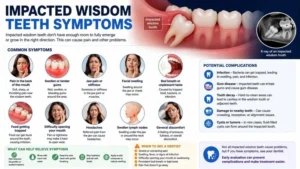
Pain Near the Back of the Jaw
This is usually the first sign people notice. The pain tends to sit behind the last visible molar and can range from a mild, intermittent ache to a sharp, throbbing sensation. It often gets worse when chewing, since pressure on the erupting tooth irritates the surrounding tissue.
Pain from wisdom teeth is frequently described as coming in waves flaring for a few days, easing off, then returning weeks or months later as the tooth shifts or tries to erupt further.
Swollen or Tender Gums
As a wisdom tooth pushes against the gum tissue, the area often becomes red, puffy, and sore to the touch. You might notice a small flap of gum tissue partially covering the tooth (called an operculum). This flap can trap food particles and bacteria, which is one of the most common triggers for infection in this area.
Difficulty Opening Your Mouth Fully
Swelling and inflammation around an emerging wisdom tooth can affect the surrounding jaw muscles, making it uncomfortable or difficult to open your mouth wide. Dentists refer to this as trismus. It’s a strong indicator that inflammation has spread beyond the gum tissue itself and is worth having evaluated.
Bad Breath or an Unpleasant Taste
A partially erupted wisdom tooth creates a pocket where food debris and bacteria can accumulate, since it’s nearly impossible to clean thoroughly with a toothbrush alone. This buildup often causes persistent bad breath or a lingering unpleasant taste, even after brushing.
Jaw Ache, Headaches, or Ear Pain
Because the nerves and muscles around the back of the jaw are closely connected to the temples, ears, and neck, wisdom tooth problems can produce pain that seems to radiate well beyond the mouth. Some people mistake this referred pain for a headache, earache, or general jaw tension (sometimes overlapping with TMJ-type discomfort) before realizing the actual source is a wisdom tooth.
Swollen Lymph Nodes
If inflammation around a wisdom tooth progresses into an infection, the lymph nodes under the jaw or in the neck can become swollen and tender. This is the body’s immune response working to contain the infection, and it typically appears alongside other symptoms like pain, swelling, or fever rather than on its own.
Swelling in the Cheek or Face
In more advanced cases, swelling can extend beyond the gums into the cheek, giving the face a visibly puffy appearance on the affected side. This level of swelling usually points to an active infection and warrants prompt dental attention rather than home management.
Crowding or Shifting of Nearby Teeth

Because wisdom teeth often don’t have adequate space to erupt properly, they can push against the second molars, gradually contributing to crowding or shifting elsewhere in the dental arch. This symptom develops more slowly than the others and is often picked up during a routine dental check-up rather than noticed by the patient.
Symptoms by Wisdom Tooth Type
Not all wisdom teeth behave the same way, and the symptoms often depend on how the tooth is positioned.
| Wisdom Tooth Type | What’s Happening | Typical Symptoms |
| Fully erupted | Tooth breaks through the gum completely and aligns normally | Often no symptoms; functions like a normal molar |
| Partially erupted | Tooth breaks through only partly, leaving a gum flap over part of the crown | Recurring soreness, swelling, bad taste, risk of infection under the flap |
| Impacted (soft tissue) | Tooth is trapped under the gum but has cleared the jawbone | Localized pressure, tenderness, occasional swelling |
| Impacted (bony) | Tooth is fully or partially trapped within the jawbone | Deep, dull ache; pressure on neighboring teeth; may stay symptom-free for long periods |
| Angled/impacted against neighbor | Tooth grows sideways into the second molar | Pain concentrated at the second molar, crowding, possible damage to the neighboring tooth’s root |
When Symptoms Signal a Complication
Most wisdom tooth discomfort is uncomfortable but not dangerous. However, certain symptoms point to complications that need prompt professional care rather than home management.
Pericoronitis
Pericoronitis is inflammation of the gum tissue surrounding a partially erupted wisdom tooth. It develops when bacteria and food debris become trapped under the gum flap. Symptoms include intense localized pain, swelling, a foul taste, and sometimes difficulty swallowing or opening the mouth. Left untreated, pericoronitis can spread to nearby tissue and become a more serious infection.
Dental Abscess
An abscess is a pocket of infection that can form around the root of an impacted or infected wisdom tooth. Signs include throbbing pain, visible swelling, warmth in the area, a bad taste from draining pus, and sometimes fever. An abscess is a dental emergency and requires prompt treatment.
Cysts
In less common cases, a fluid-filled cyst can develop around an impacted wisdom tooth that hasn’t erupted. Cysts often cause no symptoms early on but can gradually damage the jawbone or nearby tooth roots if left unaddressed, which is why dentists monitor impacted teeth with periodic X-rays even in the absence of pain.
Damage to Neighboring Teeth
Wisdom teeth that grow at an angle can press directly against the roots of the second molar, sometimes causing decay, bone loss, or resorption of that tooth’s root. This kind of damage often develops silently and is another reason routine dental imaging matters, even for people who feel fine.
Can Wisdom Teeth Cause No Symptoms at All?
Yes. It’s entirely possible to have wisdom teeth including impacted ones without any noticeable pain, swelling, or discomfort. This is why dentists rely on periodic X rays rather than symptoms alone to track how wisdom teeth are developing a tooth can sit impacted for years without causing trouble, then suddenly start showing symptoms once it shifts position or a gum flap becomes irritated. The absence of symptoms doesn’t necessarily mean the situation is stable long-term, which is a key reason dentists recommend monitoring rather than ignoring wisdom teeth entirely.
Wisdom Tooth Pain vs. Other Dental Problems
Several other dental issues can mimic wisdom tooth symptoms, which makes self-diagnosis tricky. This comparison can help narrow things down, though a dentist’s exam and X-rays are the only reliable way to confirm the cause.
| Symptom Pattern | Likely Wisdom Tooth Issue | More Likely a Different Issue |
| Pain concentrated at the very back of the jaw | Yes | |
| Pain in a single tooth with sensitivity to hot/cold | Possible cavity or exposed nerve | |
| Pain with visible swelling and bad taste near the last molar | Yes | |
| Sharp pain when biting down on a specific front or middle tooth | Possible cracked tooth or old filling issue | |
| Jaw stiffness plus clicking or popping sounds when chewing | Possible TMJ disorder | |
| Gradual crowding of front teeth over months | Possibly (if wisdom teeth are pushing) | Could also be natural shifting unrelated to wisdom teeth |
| Pain radiating to the ear on one side, worse with mouth opening | Yes | Could also be TMJ or an ear infection |
When to See a Dentist
Some symptoms call for a routine appointment; others call for prompt or same-day care. It’s worth treating these differently.
Schedule a routine visit if you notice:
- Mild, intermittent soreness near the back molars
- Occasional bad breath localized to one side of the mouth
- Slight gum swelling that comes and goes
Seek prompt dental care if you experience:
- Persistent or worsening pain that doesn’t improve within a few days
- Visible facial swelling
- Difficulty opening your mouth or swallowing
- Fever alongside jaw or gum pain
- Pus or an unusual taste that suggests drainage from an infection
- Pain that spreads to the ear, throat, or neck
Facial swelling combined with fever or difficulty swallowing should be treated as urgent, since these can indicate an infection that is spreading beyond the local area.
How Dentists Diagnose Wisdom Tooth Problems

A dentist typically starts with a visual and physical exam of the back of the mouth, checking for swelling, gum flaps, and signs of decay or infection. From there, a panoramic X ray (sometimes a 3D cone-beam scan for more complex cases) is used to see the exact position of the tooth, how it relates to the jawbone and nerves, and whether it’s impacted.
This imaging step matters because many wisdom tooth issues like early-stage impaction or a developing cyst aren’t visible or obvious from symptoms alone.
Managing Symptoms Before Your Appointment
While waiting to see a dentist, a few general measures can help ease discomfort. These are meant to provide short-term relief, not treat the underlying cause:
- Rinse with warm salt water several times a day to help reduce bacteria and soothe irritated gum tissue.
- Apply a cold compress to the outside of the jaw to help reduce swelling.
- Stick to soft foods and avoid chewing directly on the affected side.
- Maintain gentle oral hygiene around the area, brushing carefully to avoid further irritating inflamed gums.
- Avoid probing the area with your tongue, fingers, or sharp objects, which can worsen irritation or introduce more bacteria.
Over-the-counter pain relief may help in the short term, but the right option and dosage depend on your individual health history, so this is best discussed with a pharmacist or dentist rather than decided from general advice. These measures are not substitutes for a dental evaluation, especially if symptoms are worsening.
Treatment Options Once a Dentist Evaluates the Tooth
After examining the tooth and reviewing imaging, a dentist will generally recommend one of two paths:
- Monitoring. If the wisdom tooth is positioned normally, not causing damage, and not producing symptoms, many dentists recommend simply monitoring it with periodic check-ups and X rays rather than removing it.
- Extraction. If the tooth is impacted, causing pain, damaging neighboring teeth, or has a high likelihood of future complications, removal is typically recommended. Extractions can often be done in a dental office, though more complex impactions may be referred to an oral surgeon.
The right choice depends heavily on the individual case tooth position, age, overall oral health, and symptom severity all factor in so this decision should always be made with a dentist who has reviewed your specific X-rays, not based on general symptom descriptions alone.
Common Mistakes People Make
- Waiting too long to get evaluated. Mild, intermittent symptoms often get dismissed until they escalate into an infection that’s harder to treat.
- Assuming no pain means no problem. As covered above, impacted or angled wisdom teeth can cause silent damage to nearby teeth or bone.
- Self-diagnosing based on symptoms alone. Pain near the back of the jaw can come from several different sources, and only an exam with imaging can confirm the actual cause.
- Ignoring recurring gum flap irritation. Repeated bouts of soreness around a partially erupted tooth are a strong sign of a gum flap trapping bacteria, which tends to keep recurring until addressed.
- Ignoring facial swelling or fever. These are signs of a spreading infection that need prompt attention rather than home remedies.
Best Practices for Managing Wisdom Teeth Long-Term
- Get a panoramic X-ray in your late teens or early twenties, even without symptoms, so a dentist can track how your wisdom teeth are developing.
- Keep up with regular dental check-ups, since these catch developing issues like a cyst or root pressure before symptoms appear.
- Practice thorough hygiene around erupting teeth, using a soft-bristled brush and, if recommended by your dentist, a water flosser to reach difficult spots near a gum flap.
- Don’t ignore a pattern of recurring soreness. A single flare-up might resolve on its own, but repeated episodes usually indicate an ongoing structural issue that won’t fix itself.
- Ask your dentist directly about your personal risk factors. Jaw size, tooth angle, and family history all affect whether monitoring or extraction makes more sense for you.
Frequently Asked Questions
How do I know if it’s my wisdom teeth causing the pain and not something else? Wisdom tooth pain is usually concentrated at the very back of the jaw, behind the last visible molar, and often comes with gum swelling or a bad taste. Pain from a cavity or cracked tooth tends to be localized to one specific tooth and often reacts to hot, cold, or sweet foods. An exam is the only way to confirm the source with certainty.
Can wisdom teeth symptoms come and go for months or years? Yes. It’s common for wisdom tooth discomfort to flare up for a few days, subside, and return later as the tooth shifts slightly or a gum flap becomes irritated again. This on and off pattern is itself a useful clue that a wisdom tooth may be involved.
Do all wisdom teeth need to be removed? No. Wisdom teeth that are properly aligned, fully erupted, and not causing damage or symptoms can often be left in place and simply monitored. Removal is generally recommended when a tooth is impacted, infected, or damaging neighboring teeth.
Can wisdom teeth cause headaches? Yes, indirectly. Inflammation and muscle tension around an erupting or impacted wisdom tooth can produce referred pain that feels like a headache or ear ache, even though the source is in the jaw.
Is swelling always a sign of infection? Not always mild, localized gum swelling can simply be a response to an erupting tooth. However, swelling that extends into the cheek or face, especially alongside fever, is more likely to indicate an infection and should be evaluated promptly.
At what age do wisdom teeth symptoms usually start? Most people begin noticing symptoms between ages 17 and 25, when wisdom teeth typically start to emerge, though the exact timing varies significantly from person to person.
Can I wait out wisdom tooth pain without seeing a dentist? Mild, short-lived discomfort sometimes resolves on its own as a tooth finishes erupting. However, recurring or worsening symptoms usually indicate an underlying issue, such as impaction or infection, that won’t resolve without treatment.
The Bottom Line
Wisdom tooth symptoms range from mild, occasional soreness to clear signs of infection like swelling, fever, and difficulty opening your mouth. The pattern and severity of what you’re feeling say a lot about how urgently it needs attention, but imaging is the only way to know exactly what’s happening beneath the gum line. If you’re noticing recurring pain, swelling, or bad breath near your back molars, the most useful next step isn’t guessing it’s getting an X-ray and a professional evaluation so you know whether monitoring or removal is the right path for your specific case.

Raheel is the founder of WisdomToothPain. info, a specialized platform dedicated to demystifying dental health. As a dedicated digital researcher, Raheel focuses on providing clear, accurate, and evidence-based information to help individuals navigate the complexities of wisdom tooth pain with confidence. This content is for informational purposes only and isn’t a substitute for professional dental advice. Always consult a licensed dentist for diagnosis and treatment.