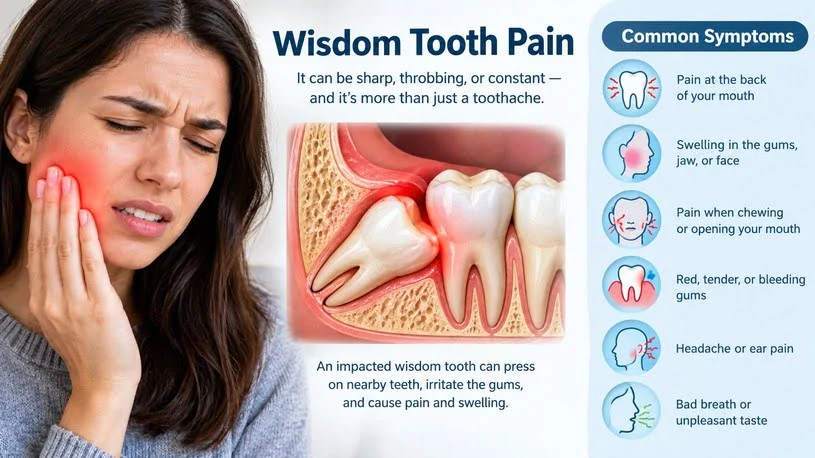
A dull throb at the very back of your jaw that worsens when you chew, a jaw that feels tight and swollen, and a sharp jolt every time cold water touches your back teeth wisdom tooth pain rarely shows up quietly. For most people, it starts sometime between the late teens and mid-twenties, when the third molars, commonly called wisdom teeth, try to push through gum tissue that often doesn’t have enough room to hold them. Because the jaw has usually finished growing by this point, these last four teeth frequently arrive at an angle, get stuck partway through the gum, and press directly against the roots of the neighboring molar. Any of those situations can turn ordinary tooth eruption into days and even weeks of real discomfort.
Wisdom tooth pain isn’t a single sensation. It can feel like steady pressure, a constant ache, a sharp stab when you bite down, and soreness that radiates into the jaw, ear, and side of the head. The pattern of the pain actually says a lot about what’s happening beneath the gum. Pain that’s mild, intermittent, and builds gradually over several weeks can be associated with a tooth slowly working its way to the surface. Pain that’s sudden, sharp, and paired with swelling, a bad taste, and difficulty opening your mouth can be a sign of infection around a partially erupted tooth, a condition dentists call pericoronitis.
This distinction matters because the right response depends on the cause. Pain from a normal eruption typically responds well to simple home care: a cold compress, warm salt water rinses, and an over-the-counter pain reliever can get you through the worst of it within a few days. Pain from an impacted tooth, a trapped infection, and a tooth pressing on a nerve will usually ease temporarily with the same home remedies but keeps coming back, because nothing at home can fix the structural problem underneath. In those cases, a dentist needs to see what’s actually going on, often with an X-ray, before the pain resolves for good.
Wisdom teeth pain can also be confused with other issues nearby, such as a cavity in the second molar, jaw joint (TMJ) strain, and a sinus infection that presses on the upper back teeth which is one reason a dentist’s exam matters more than guessing. Below is a breakdown of why wisdom tooth pain happens, the earliest signs your wisdom teeth are coming in, what actually helps at home, and the specific warning signs that mean it’s time to call a dentist rather than wait it out.
What Causes Wisdom Tooth Pain?
Most wisdom tooth pain comes down to one of a few structural problems:
- The tooth is angled sideways, backward, and trapped under bone and gum tissue and can’t fully erupt.
- Partial eruption part of the tooth breaks through the gum while the rest stays covered, creating a flap of tissue where food and bacteria collect.
- Pericoronitis inflammation and infection of that trapped tissue, which causes swelling, tenderness, and often a bad taste and odor.
- Crowding the erupting wisdom tooth pushes against the second molar, causing pressure pain and sometimes damage to that tooth’s root.
- Cysts less commonly, fluid-filled sacs can form around an impacted tooth and put pressure on the jawbone and nerve.
First Signs Your Wisdom Teeth Are Coming In
Before pain becomes obvious, most people notice a handful of early clues at the very back of the mouth:
- Tenderness and a dull ache behind the last visible molar
- Mild swelling and puffiness of the gum in that area
- A small flap of gum tissue partially covering a new tooth edge
- Slight difficulty fully opening the mouth
- An ache that’s worse at night and when chewing on that side
- Mild ear discomfort and a faint headache on the same side
These early signs can come and go for weeks and months as the tooth gradually erupts, especially if there’s enough space in the jaw for it to come in fairly straight.
How Long Does Wisdom Tooth Pain Last?
Wisdom tooth pain from normal eruption typically comes and goes over several weeks, often flaring for a few days as the tooth pushes further through the gum, then easing before the next stage. This on-and-off pattern is common because wisdom teeth rarely erupt in one smooth motion. Pain linked to an infection and an impacted tooth tends to behave differently; it often returns again and again rather than fully resolving, sometimes over months, until the underlying cause is treated. If discomfort lasts longer than a week without improvement, and keeps coming back, it’s worth having a dentist check the tooth’s position rather than continuing to wait it out.
How to Help Wisdom Tooth Pain at Home
For mild to moderate discomfort from normal eruption, these steps are the most effective wisdom teeth pain relief methods before you can get to a dentist:
- Rinse with warm salt water. Dissolve about half a teaspoon of salt in a cup of warm water and swish gently several times a day. This can help soothe irritated gum tissue and keep the area cleaner.
- Apply a cold compress. Hold it against the outside of the jaw for 15–20 minutes at a time to reduce swelling and numb the area.
- Use an over-the-counter pain reliever. Ibuprofen and acetaminophen may help relieve pain when used according to the package directions and if they’re safe for you to take.
- Stick to soft, lukewarm foods. Yogurt, mashed potatoes, soup, and scrambled eggs won’t irritate the area the way crunchy and very hot foods will.
- Keep the area gently clean. Clean the area gently with a soft toothbrush, taking care not to irritate the gum.
- Avoid smoking and alcohol-based mouthwash. Both can irritate inflamed gum tissue and slow healing.
Home care can manage discomfort, but it doesn’t correct an impacted tooth and clear a deep infection. It buys time until you can be seen.
When Wisdom Tooth Pain Spreads to the Jaw
It’s common for wisdom teeth pain to stop feeling like a “tooth problem” and start feeling like jaw pain. This happens because the third molars sit close to the jaw joint and the muscles used for chewing. An infected and impacted wisdom tooth can cause:
- Aching along the jawline and up toward the ear
- Difficulty opening the mouth all the way (called trismus)
- Swollen, tender lymph nodes under the jaw
- Pain that seems to move toward the temple and side of the head
Jaw pain that comes with swelling, fever, and an inability to open the mouth normally can be a sign the infection has spread beyond the gum tissue and needs prompt dental attention.
Can Wisdom Tooth Pain Cause Ear Pain?
Yes wisdom tooth pain can radiate toward the ear, since the back teeth, jaw muscles, and surrounding nerves share nearby pathways. This is especially common with impacted lower wisdom teeth. That said, ear pain has many other possible causes, including ear infections and jaw joint issues, so persistent and severe ear pain is worth having checked by a dentist and another healthcare professional rather than assuming it’s dental in origin.
Home Care vs. Dental Visit: Quick Comparison
| Symptoms | Possible Cause | What to Do |
| Mild, intermittent ache without swelling | Eruption | Gentle home care and monitor |
| Swelling, bad taste, tender gum flap | Possible pericoronitis | Arrange a dental evaluation |
| Fever, facial swelling, difficulty opening mouth | Possible spreading infection | Seek prompt dental care |
| Pain that repeatedly returns | Possible impaction and recurrent infection | Dental evaluation |
| Sharp pain near the neighboring molar | Possible pressure and decay | Dental examination and possible X-ray |
When to See a Dentist
Call a dentist promptly if wisdom tooth pain comes with any of the following:
- Fever and facial swelling
- Rapidly increasing facial and neck swelling
- Pus, a persistent bad taste, and foul odor
- Difficulty swallowing and breathing (seek emergency care immediately)
- Pain that lasts more than a week despite home care
- Pain that keeps recurring every few weeks and months
A dentist can take an X-ray to see the tooth’s position, treat any active infection, and determine whether the tooth simply needs more time and should be removed.
Conclusion
Wisdom tooth pain usually falls into one of two categories: a tooth that’s slowly and normally erupting, and a tooth that’s impacted, infected, and crowding its neighbor. Mild, intermittent wisdom tooth pain often responds well to salt water rinses, a cold compress, and an over-the-counter pain reliever. But pain paired with swelling, fever, jaw stiffness, and a bad taste can be a sign the issue needs a dentist’s evaluation rather than more home care. Paying attention to how the pain behaves and acting quickly when warning signs appear is the most reliable way to keep a normal part of growing up from turning into a dental emergency.
FAQ
How long does wisdom tooth pain usually last? Pain from normal eruption often comes in waves over several weeks as the tooth gradually breaks through the gum. Pain from an infection and impaction typically doesn’t fully go away on its own and tends to return until the underlying cause is treated.
Can wisdom tooth pain go away without removal? Yes, if the tooth is erupting normally with enough room in the jaw, pain can subside once it fully comes in. Impacted and repeatedly infected wisdom teeth, however, usually need to be removed for the pain to resolve permanently.
Why does my jaw hurt on one side near my wisdom tooth? Wisdom teeth sit close to the jaw joint and chewing muscles, so inflammation and infection around the tooth can radiate into the jawline, ear, and temple on that side.
Can wisdom tooth pain cause ear pain? Yes, it can. The back teeth, jaw muscles, and nearby nerves share overlapping pathways, so pain from an erupting and impacted wisdom tooth can radiate toward the ear. Persistent and severe ear pain should still be checked by a dentist and doctor, since it can also have non-dental causes.
Do all wisdom teeth need to be removed? No. Wisdom teeth that erupt fully, sit in a good position, and don’t cause crowding and infection can often stay in place with regular checkups and cleaning.
What does it mean if wisdom tooth pain comes with a headache? Pressure and inflammation from an erupting and infected wisdom tooth can radiate upward through the jaw muscles, sometimes causing a tension-type headache and ear ache on the same side.

Raheel is the founder of WisdomToothPain. info, a specialized platform dedicated to demystifying dental health. As a dedicated digital researcher, Raheel focuses on providing clear, accurate, and evidence-based information to help individuals navigate the complexities of wisdom tooth pain with confidence. This content is for informational purposes only and isn’t a substitute for professional dental advice. Always consult a licensed dentist for diagnosis and treatment.


Pingback: Wisdom Tooth Pain: Causes, Signs & Fast Relief Tips - wisdomtoothpain.info
Pingback: Wisdom Molar Pain: Causes, Relief & When to See a Dentist - wisdomtoothpain.info